
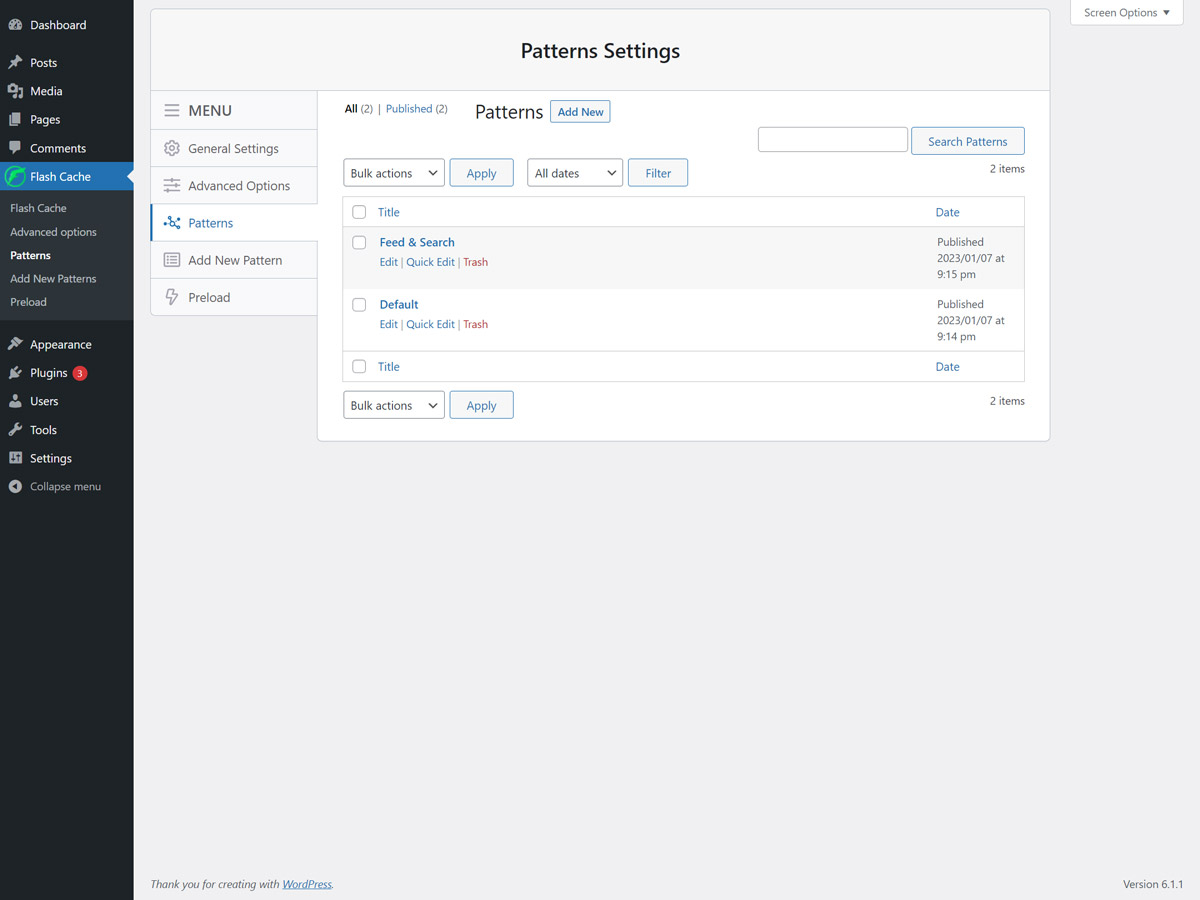
With patterns, Flash Cache lets you decide which pages are cached, and how. Each pattern applies to some types of pages, and you can create as many patterns as you need. For example, one pattern for your posts and pages, and another one with a shorter time for the home page.
Go to Flash Cache → Patterns to see your patterns, or to Flash Cache → Add New Pattern to create one. Give the pattern a name and fill in the Pattern Data box.
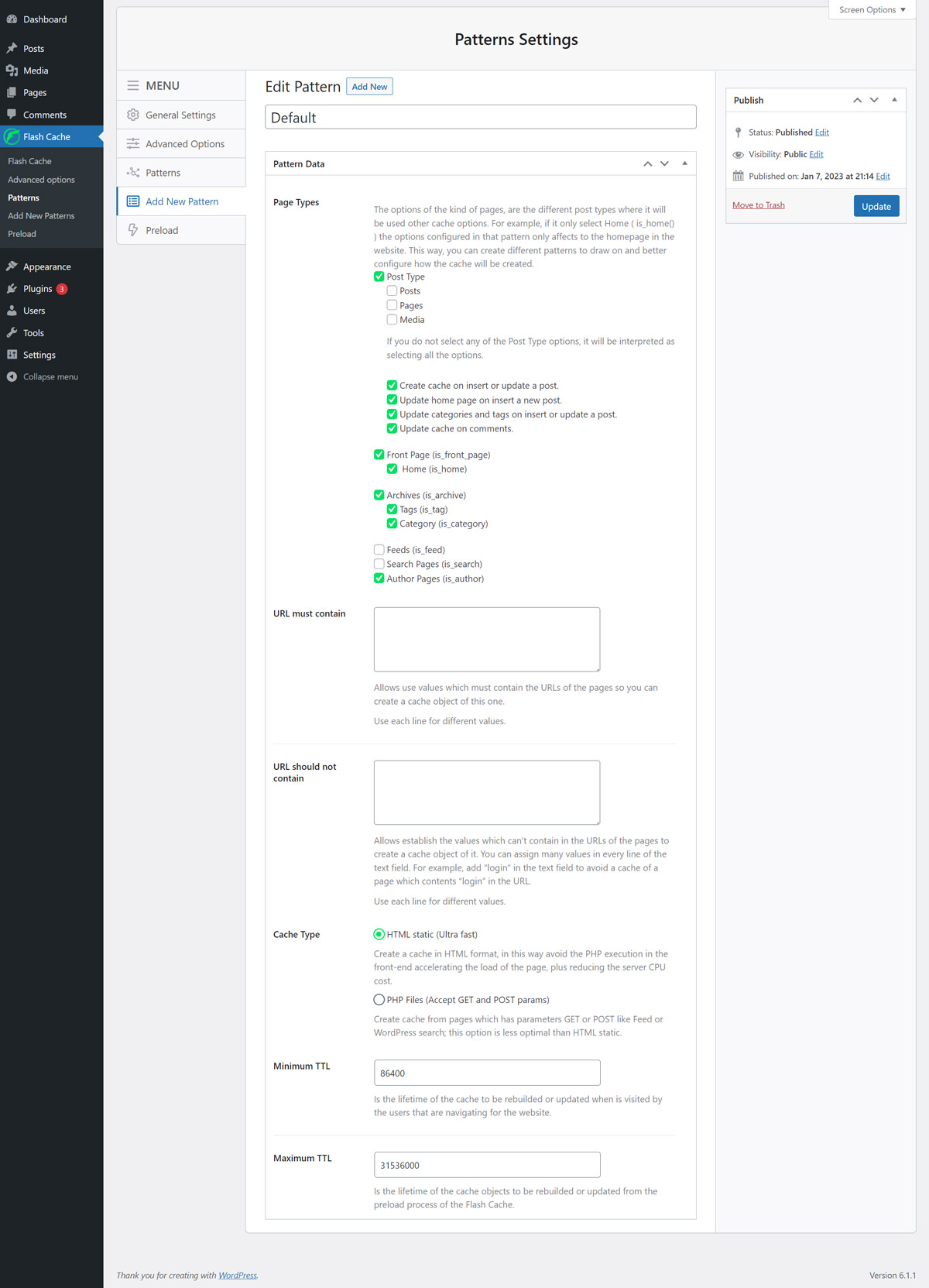
Check the types of pages that use this pattern: Post Type (the single entries, with a checkbox for each public post type of your site, like posts and pages), the front page, the home page, archives, tags, categories, feeds, search pages and author pages. For example, if you check only Home (is_home), the pattern applies only to the home page of your site.
If you don’t check any of the post types, the pattern applies to all of them.
Below the page types, choose when Flash Cache updates the cache by itself:
- Create cache on insert or update a post.
- Update home page on insert a new post.
- Update categories and tags on insert or update a post.
- Update cache on comments.
- URL must contain: the pattern caches only the pages whose URL contains one of these values.
- URL should not contain: the pattern doesn’t cache the pages whose URL contains one of these values. For example, add
loginto avoid caching any page with “login” in its URL.
- HTML static (Ultra fast): saves the page as an HTML file. Your server sends it without running PHP, so the page loads faster and the server uses less CPU.
- PHP Files (Accept GET and POST params): caches pages that use GET or POST parameters, like the feeds or the WordPress search. It’s slower than HTML static.
- Minimum TTL: after this time, the cache of a page is created again when a visitor opens it. The default is 86400 seconds (one day). The update options above can renew the cache before this time.
- Maximum TTL: after this time, the preload process creates the cache of the page again. The default is 31536000 seconds (one year).
Click Publish to save the pattern.